Now Reading: House of Iron Doors redefines the boundary as inhabitable architecture in Tbilisi
- 01
House of Iron Doors redefines the boundary as inhabitable architecture in Tbilisi

House of Iron Doors redefines the boundary as inhabitable architecture in Tbilisi

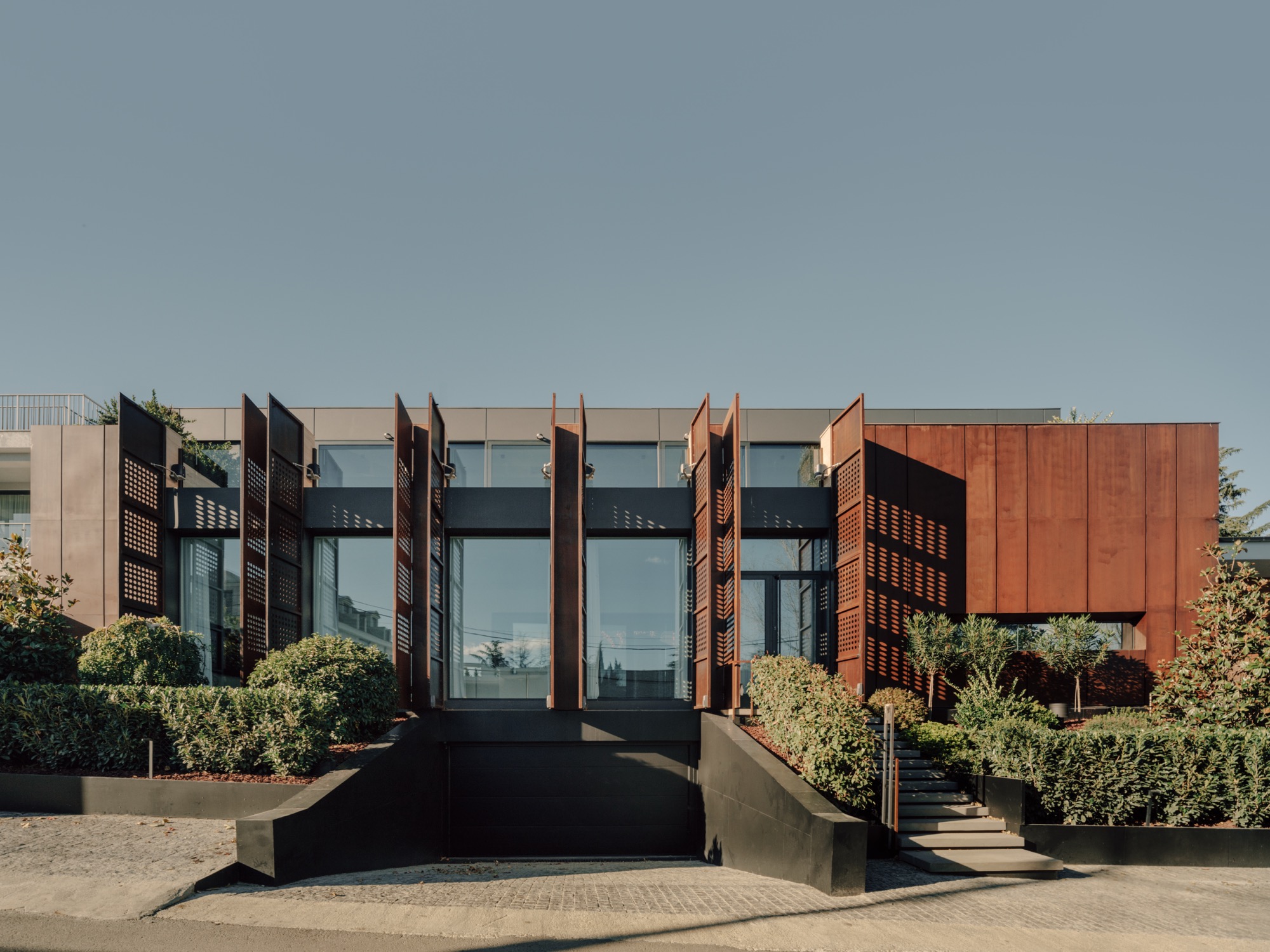
Set within the hillside district of Okrokana, overlooking Tbilisi, the House of Iron Doors proposes a radical inversion of the suburban domestic model. In a context where houses are typically concealed behind high perimeter walls, the project eliminates the distinction between building and boundary. Architecture itself becomes the enclosure.

Rather than reproducing the fragmented streetscape defined by fences, the house forms a continuous protective perimeter around the site. Its street façade appears as a monolithic surface of weathered steel, interrupted only by a sequence of large perforated iron doors. These pivoting panels operate as both environmental filter and spatial device. When closed, the building reads as a solid shield, reinforcing privacy and protection. When opened, it transforms into a permeable structure, allowing air, light, and views to penetrate deep into the interior.


The perforated surfaces introduce a temporal dimension to the façade. Light filters through the openings, casting shifting patterns across floors and walls throughout the day. What appears rigid and defensive from the outside reveals a dynamic and responsive interior condition.


Behind this outer layer, the house is organized around an inward-facing courtyard. All primary living spaces turn away from the street and orient toward this internal landscape. The strategy allows for openness without exposure, creating a domestic environment that is both transparent and protected. The courtyard becomes the spatial core of the project, bringing daylight, vegetation, and continuity across different levels of the house.

On the ground floor, living, dining, and kitchen areas unfold linearly along the garden edge. Large sliding glass panels dissolve the boundary between inside and outside, extending daily life into the courtyard. The upper level continues this logic, with private rooms maintaining visual connections to the internal landscape while remaining shielded by the outer steel envelope.


A secondary layer of operable exterior panels functions as sun control, regulating daylight and reducing solar gain. Their rhythmic placement reinforces the architectural identity of the house, constantly shifting in appearance depending on their position and the angle of the sun.


Materially, the project is defined by contrast. The exterior expresses weight and permanence through oxidized steel, while the interior adopts a restrained palette of white surfaces and light flooring. Within this calm environment, light becomes the primary medium. Filtered through perforated screens, it produces soft, evolving patterns that animate the domestic space.
Additional functions are distributed vertically. The lower level accommodates parking and technical spaces, while upper levels introduce amenities such as an indoor pool and terraces. These elements extend the spatial logic of enclosure and openness, maintaining a consistent relationship between light, privacy, and landscape.


By transforming the perimeter wall into an inhabitable architectural system, the House of Iron Doors redefines the relationship between dwelling and boundary. It replaces separation with integration, proposing a controlled interior world shaped by light, material, and the precise calibration of openness.
Project Credit
Location: Okrokana, Tbilisi, Georgia
Design firm: TIMM Architecture / @timmarchitecture
Photo: Grigory Sokolinsky / @grigorysokolinsky
More Photos