
Now Reading: Architecture as Improvisation: Building within the logic of the forest
- 01
Architecture as Improvisation: Building within the logic of the forest


In Meditations on Don Quixote, the Spanish philosopher José Ortega y Gasset reflects on the paradox of perception. “The trees prevent us from seeing the forest,” he writes, only to invert the proverb: it is precisely because the trees obscure the totality that the forest exists. The visible conceals the latent; what is present gives depth to what remains hidden. We understand we are inside a forest not by mastering it, but by sensing that beyond what we see lies something more.

This philosophical inversion becomes the conceptual ground for A Forest in the House, a residential project that approaches architecture as a layered field of presences and absences. Here, trees are not obstacles to construction. They are the very condition of possibility for it.


COMPOSING SPACE
There is a profound affinity between architecture and music, not in their final form but in the act of composition. Music unfolds in time, architecture in space; one is intangible, the other material. Yet both rely on structure, rhythm, silence and improvisation.
The late jazz pianist Bill Evans once described jazz as a concrete process rather than an intellectual one. Technique and theory are necessary, he suggested, but only so they can eventually be forgotten. Years of disciplined practice culminate in the freedom to relax and simply play.


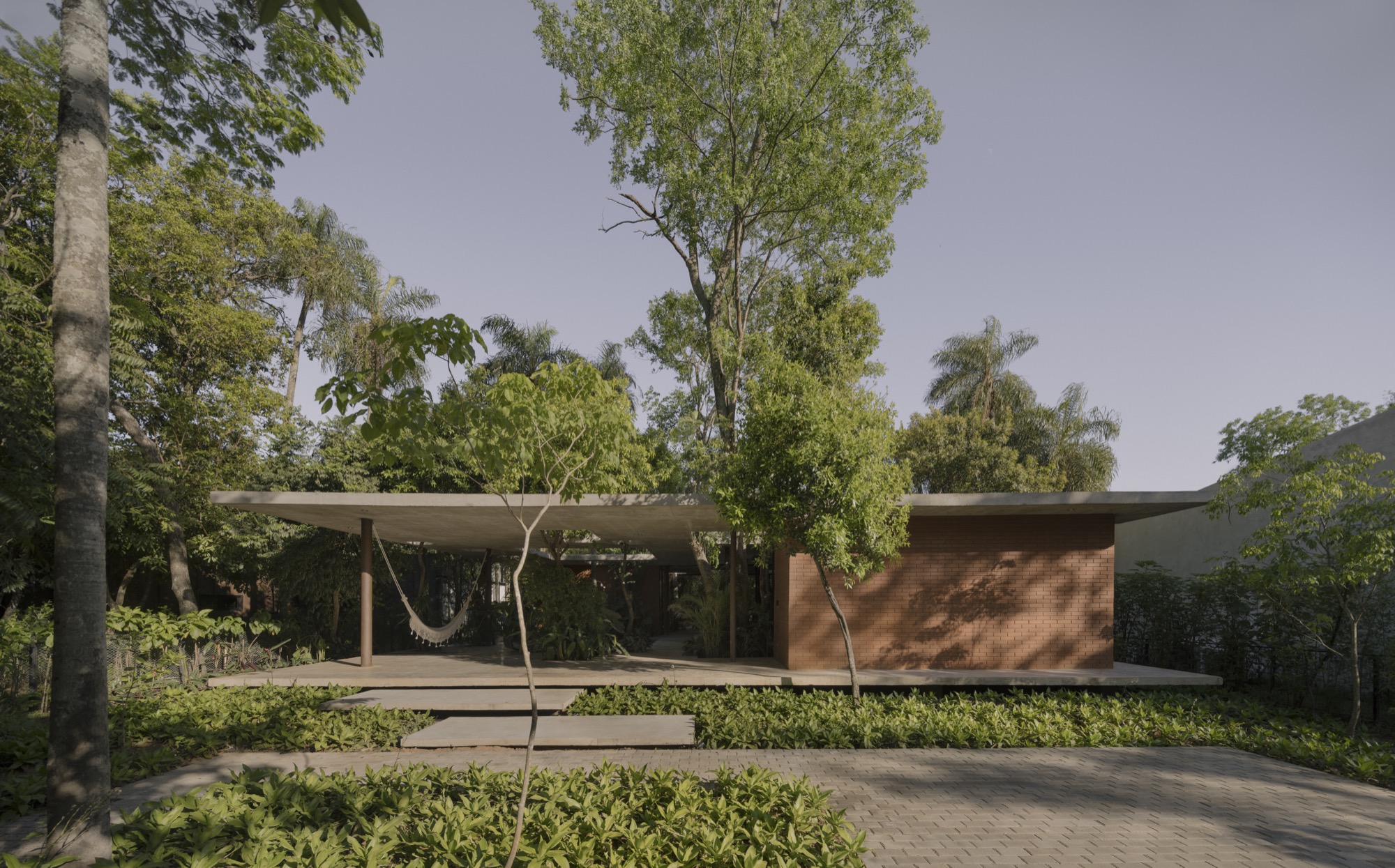
This project adopts a similar stance. The architectural “score” is defined by a single, decisive gesture: the perimeter edge of the roof. That boundary establishes the limits of intervention. Within it, solids and voids are arranged not according to an imposed grid, but in response to the pre-existing forest. Structure becomes improvisation within constraint.

Like a jazz ensemble, the composition unfolds through turns and intervals. Silences, here translated into voids, are as essential as walls. Rhythm emerges from the irregular placement of pillars among trunks. The house does not overwrite the site; it listens to it.

Light and wind further articulate this score. Natural light marks time across the surfaces of compressed earth and timber, casting shifting shadows that alter the atmosphere hour by hour. The subtle gradations of brightness recall the tonal explorations of John Abercrombie in Timeless, where resonance and pause shape the musical field as much as melody. The wind moving through the leaves introduces another register, a percussive murmur akin to the brushed rhythms of Philly Joe Jones alongside the Miles Davis Quintet.

TREES AS STRUCTURE
Rather than clearing the plot to assert architectural order, the project allows the trees to determine spatial logic. Their trunks delineate inhabited zones and open areas, shaping the domestic program through proximity and distance. In doing so, the house relinquishes the orthogonal grid that traditionally governs residential planning.


This non-orthogonal arrangement of vertical elements is not merely poetic. It contributes to the building’s lateral stability, transforming ecological sensitivity into structural intelligence. Columns are positioned carefully among the trunks, avoiding interference with root systems. Visually, they retreat into the background, aligning with the vertical rhythm of the forest and dissolving into it.

Solid volumes are constructed using compressed earth blocks, grounding the house materially within its landscape. The choice of CEBs establishes a tactile continuity between soil and wall, reinforcing the project’s commitment to a dialogue with the terrain. Artifice does not dominate nature; it extends it.

TWO HORIZONTAL PLANES
The spatial composition unfolds across two horizontal strata. The primary plane, the floor, is subtly elevated above the terrain. This slight lift allows tree roots to evolve freely over time, acknowledging growth as an ongoing process rather than a condition to be fixed at the moment of construction.

Above, a secondary plane mirrors the geometry of the first. The ceiling extends outward to form a terrace that opens toward the canopy. From this elevated platform, occupants inhabit a different forest, one composed of treetops, filtered light and shifting horizons. The house becomes both shelter and observatory.

Between these two planes, domestic life unfolds in continuity with the surrounding ecosystem. Interior and exterior are not separated by a rigid boundary but modulated through degrees of enclosure and exposure.

DISSOLVING BOUNDARIES
A Forest in the House ultimately proposes a future in which architecture no longer stands apart from its environment as a foreign object. Instead, it imagines a built form as organic as its context, a structure that acknowledges that the visible landscape always conceals other, invisible layers.

The project does not romanticize nature, nor does it retreat from technical rigor. Rather, it suggests that coexistence is a compositional strategy. Structure, material, light and vegetation operate as instruments within a single ensemble. Depending on the season or the hour of the day, the house performs differently. Its music changes, but its rhythm remains rooted in the forest.

In this sense, the proverb is reversed once more. The trees do not prevent us from seeing the architecture. They allow it to exist.


Project Credit
Design firm: Equipo de Arquitectura / @equipodearquitectura
Year: 2025
Location: San Bernardino, Paraguay
Area: 260 sqm
Photo: Federico Cairoli / @federicocairoli