
Now Reading: Beyond the Icon: A Tribute to Frank Gehry (1929–2025)
- 01
Beyond the Icon: A Tribute to Frank Gehry (1929–2025)

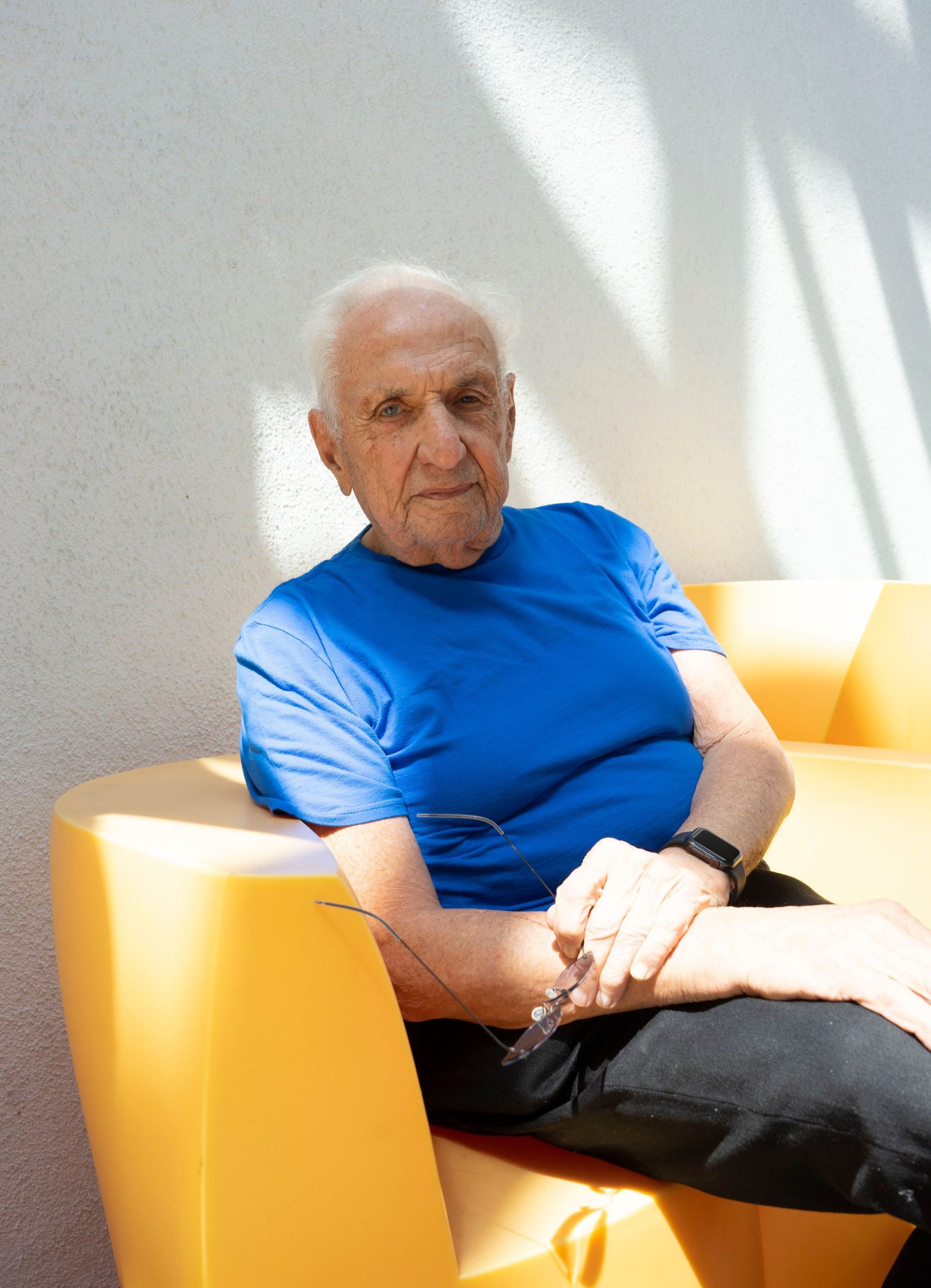

Frank Gehry (1929 – 2025) was born in Toronto on February 28, 1929, and died in Santa Monica, California, on December 5, 2025, aged 96.
This piece is written in tribute, as one way of looking back at Gehry through the lens of process rather than celebrity. It stays with the territory he and his archivists foregrounded: drawings, models, and a chain of decisions that reveal how a body of work is made.
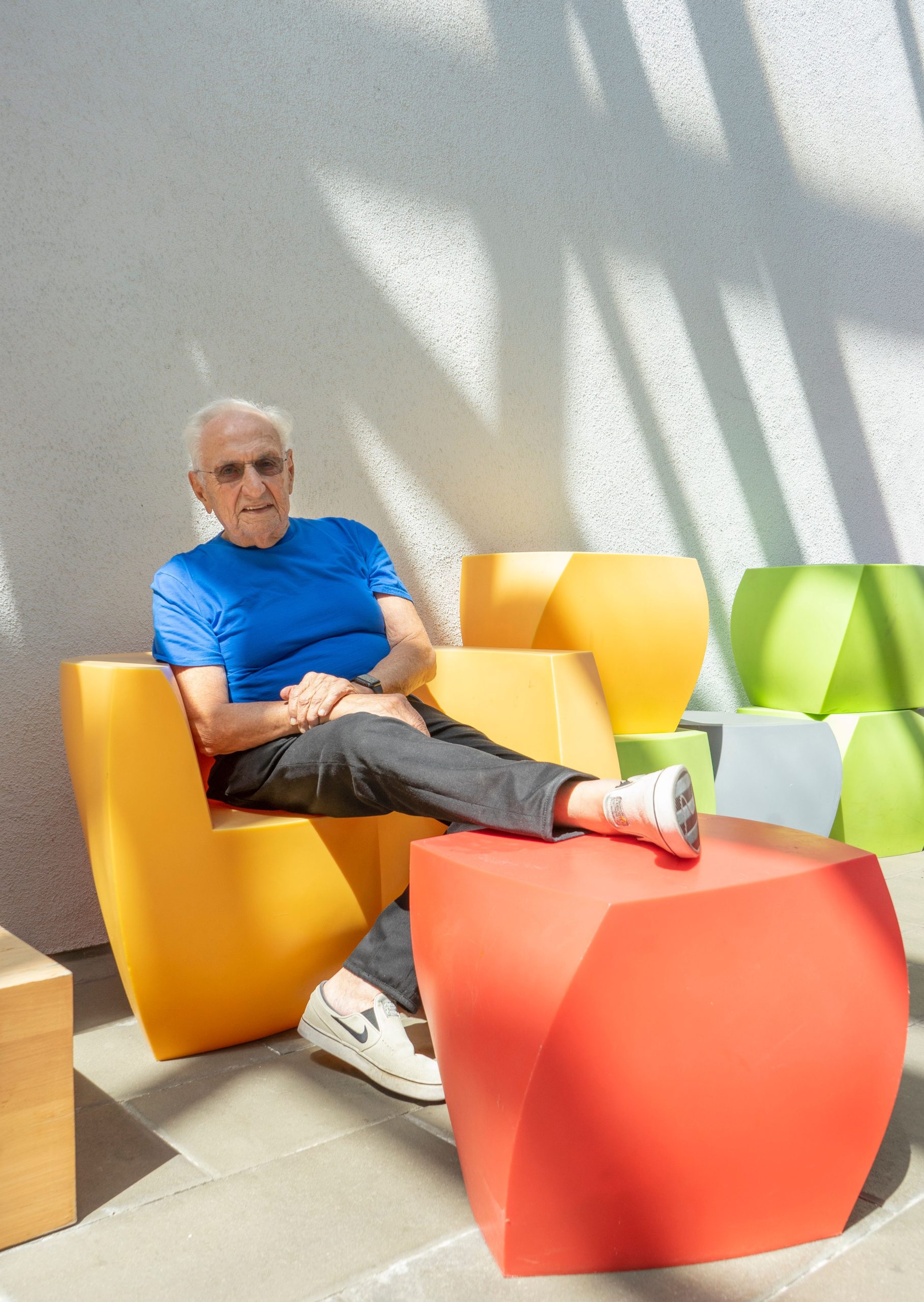
Frank Gehry is widely recognised, closely associated with Los Angeles, and a recipient of the Pritzker Prize. His name is often attached to buildings that provoke debate and draw public attention.
A different portrait emerges when the work is approached through archives rather than icons. That is the territory of Frank Gehry: Catalogue Raisonné of the Drawings Volume One, 1954 – 1978, edited by the historian Jean-Louis Cohen and published by Cahiers d’Art. It is the first instalment in an eight-volume project intended to trace Gehry’s career in full.
This first volume is significant because it documents Gehry before titanium and before the computational tools that later became associated with Gehry Partners. The material runs from his USC graduation project in 1954, positioned within a mid-century sensibility and informed by Japanese influence, to the 1978 remaking of his own house in Santa Monica, a domestic intervention that shifted assumptions about what a house could be.
Across drawings and sketches, Gehry appears as an architect whose practice is organised around iteration. He repeats, adjusts, rejects, and returns, guided by intuition yet sustained by a disciplined rhythm of making. Asked to look back through the archive and Cohen’s selections, Gehry admits he is not inclined to retrospective thinking. Some projects satisfy him, others trouble him, and his instinct is to move on. Still, he places trust in Cohen’s judgement and frames the catalogue raisonné as a tool for future readers: a body of work to study, to argue with, or to oppose, especially where the political context of certain projects now reads differently.

That stance sits in tension with the fact that Gehry’s archive is extensive, held at the Getty. He says the accumulation was not planned as legacy-making; it simply grew. A turning point in his awareness of what an archive can reveal came with a 1998 exhibition at the Louisiana Museum of Modern Art in Denmark. The curator did not select Gehry’s most celebrated projects, but a business school scheme. What mattered to Gehry was the exhibition’s method: an entire room filled with models of a single project, from early to late, version after version. The sequence made visible a pattern of incremental change, each model edging away from the previous one through repeated revision. Gehry describes the experience as recognising that the search was not accidental; it had a kind of precision shaped by testing and elimination. The project itself, he notes, was not fully resolved in his view, yet the exhibition clarified something more fundamental: his thinking is visual rather than theoretical.

That admission also locates him within the intellectual climate of the 1960s and 1970s, when architectural discourse often clustered around groups commonly labelled the Whites, Silvers, and Grays, known for philosophical debate and theoretical frameworks. Gehry does not dismiss the appeal of those conversations, but he describes them as peripheral to the questions he was trying to solve in his own work.
If architecture culture did not feel like home, art did. Gehry recalls taking night art classes at USC while driving a truck, and he credits an art history course with opening new doors in how he understood form and making. Although architecture and fine art shared the same building, he noticed how little the two worlds spoke to each other in daily life. Outside the school, however, Los Angeles offered an active art scene, and Gehry gravitated towards it.

He names Larry Bell and Ed Moses as close figures. Through Moses, Gehry entered both the social and studio life of artists, observing how work develops in the workshop and how decisions are made through trial and doubt. That network expanded to include John Chamberlain, Jasper Johns, and Robert Rauschenberg. Gehry recalls visiting Warhol’s Factory and spending nights in Rauschenberg’s studio as the artist worked through to morning, with Gehry sitting nearby to talk. What resonated was not a ready-made answer, but the struggle of making itself: the sustained effort of searching for a resolution inside the work.
The first catalogue’s endpoint is the Santa Monica house Gehry remodelled for himself and his wife, Berta, in 1978, documented through drawings, sketches, and images. The circumstances were direct. Berta found the house, Gehry’s mother encouraged the purchase, they had two young children, and the budget was limited. The kitchen was inadequate and another bedroom was needed, so the work had to proceed quickly.
The intervention began with Gehry’s attention to materials and structure. He was drawn to ordinary materials. He liked galvanized corrugated metal, disliked the way it was typically deployed, yet responded to its language. He also liked timber, connecting both to Japanese influence and to wood-frame technique. With a 12-foot side yard available for an addition, he constructed a new layer as a counterpoint to the existing house, allowing the old structure to remain legible alongside the new.
From inside, he oriented views upward and outward rather than laterally, because he did not find the surrounding street architecture compelling. From the roof, he could see the ocean and the airport. Windows were positioned to work with the large street tree canopy and to modulate light. He also paid attention to the moon’s movement, occasionally catching it through a skylight. Headlights and street reflections animated the ceiling and skylight well, producing a shifting light condition that could be noticed or ignored. The budget was around $50,000. Neighbour reactions were intense; Gehry describes complaints and a lawsuit initiated by a nearby lawyer. Later, he notes, that same neighbour remodelled in a comparable way, building a new house around an older one.
From a domestic dispute at neighbourhood scale, the narrative moves to a larger urban dispute: the Los Angeles River study. Gehry recounts being approached by people from the film industry, connected to Mayor Garcetti, with a familiar reference point, the High Line in New York. They framed the 51-mile river as a corridor linking communities and sought a strong visual identity for the river, extending from graphics to public amenities. Gehry’s response was that the comparison missed the river’s mandate: the High Line is a disused rail line, while the L.A. River is flood-control infrastructure. He nevertheless agreed to investigate. The team carried out a two-year study, looking at regional economics, public health, safety, planting feasibility, and the river’s fluctuating flow patterns.
The conclusion turned on what happens rarely but decisively. The river is calm most of the time, but a small portion of the year brings major flood events capable of sweeping interventions away. Gehry describes how, in soft-bottom stretches such as Atwater Village, storms can leave objects caught in trees, including bicycles. Managing those floods would require diverting water into basins or storage zones, which demands land. In dense neighbourhoods, reserving land for flood storage implies displacement, with direct social consequences.
From there, controversy sharpened. Gehry says critics cast him as advocating more concrete when they wanted less. He counters that he also wanted less concrete, but did not see a viable diversion strategy; tunnelling solutions were financially extreme. The direction his team considered feasible, informed by precedents elsewhere, was to cover certain river stretches where park space is needed, particularly in South L.A.

Against fears that new parks could accelerate gentrification and speculation, Gehry describes community meetings and the use of health and economic data. One figure that struck him was a claim that children in some areas have life expectancies ten years shorter, which the team confirmed. He frames the river project as a question of needs: affordable housing, housing for unhoused residents, open space, and cultural infrastructure. One proposed move was an elevated park deck covering a river segment at South Gate, at the confluence of the Rio Hondo and the L.A. River, aiming to create roughly 40 acres of walkable green space without displacing residents. He adds that the team worked with the county on affordable housing strategies and treated limiting gentrification as a core value of the study.
At the end of the account, Gehry returns to the posture that runs through the archive: to continue working rather than to settle into retrospective closure. When reminded that a project like the river could take years, he notes that he was nearing 92 and could not assume he would see the outcome. He places his confidence instead in continuity within the office, including key collaborators and his son, whom he describes as sharing the same values.
Read together, the 1954–1978 archive, the Santa Monica house, and the Los Angeles River study reveal a consistent line. Gehry does not present himself through an explanatory system. He presents a method: drawing, model-making, rejection, revision. He tests form through ordinary materials. He treats light as part of living space. And when confronted with a civic problem, he begins with survey, data, and the constraints of flood infrastructure. Dispute is present at every scale, from neighbours to contested urban visions, and the work remains open as something to be examined, argued with, learned from, or opposed.