
Now Reading: Steel, Space, Time: The artistic life of Richard Serra
- 01
Steel, Space, Time: The artistic life of Richard Serra


ENTERING THE LABYRINTH
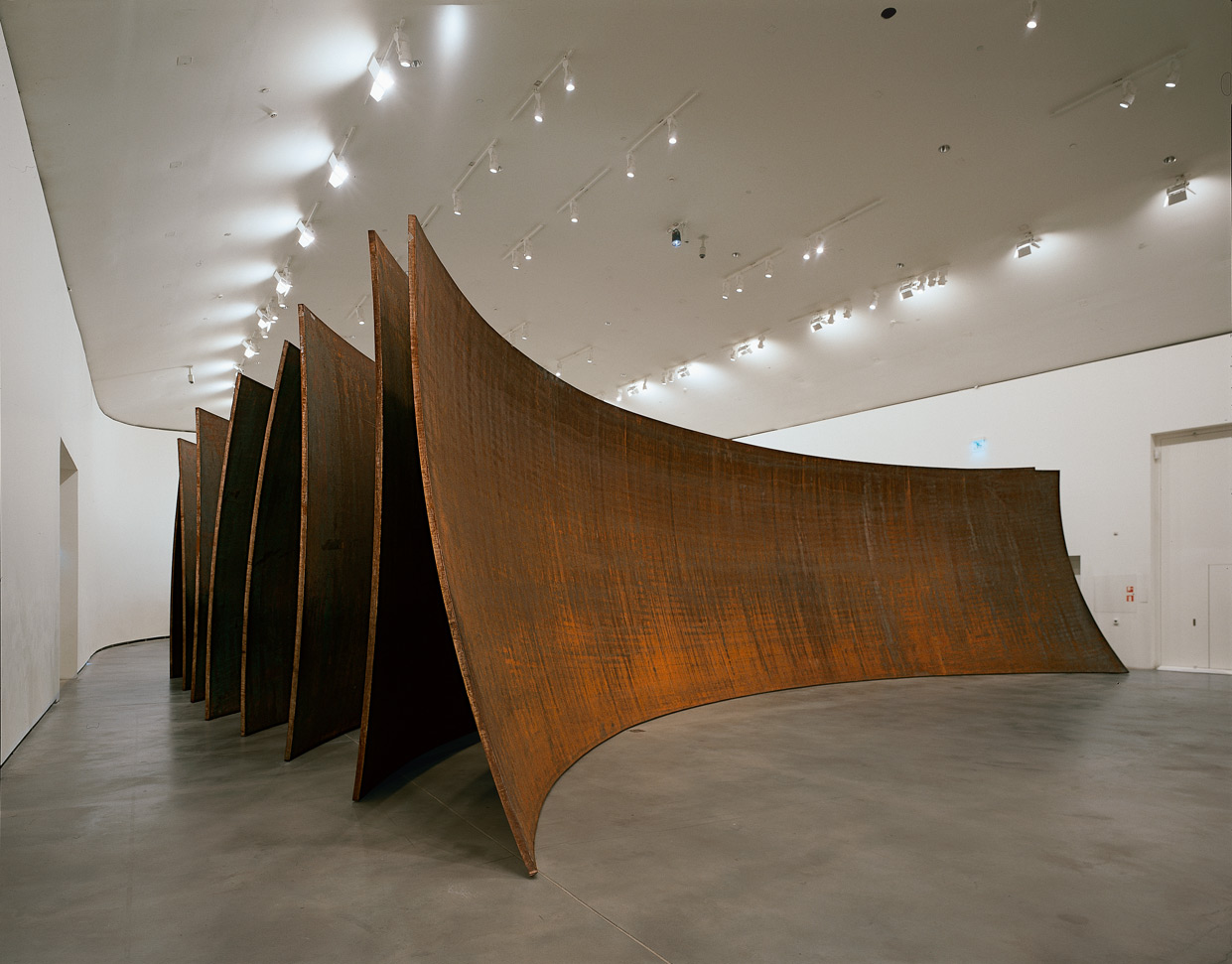
Imagine standing inside a colossal labyrinth of weathering steel, its plates rising like the eroded walls of an ancient citadel. The space does not merely surround you; it presses back. As you walk, curvature and scale recalibrate distance, while gravity seems to tug at perception itself. Light falls from above and slides across the reddish-brown surface, pooling into long shadows and sudden flares. The material feels heavy and almost immovable, yet the experience is strangely fluid, almost lyrical, as form and space braid around your body.
This is not sculpture as an object to be admired from afar. It is sculpture as a situation, an invitation to enter, to measure yourself against mass, and to discover how movement produces meaning. That experience is crystallized in The Matter of Time (1994–2005), permanently installed at the Guggenheim Museum Bilbao, where Serra’s weathering-steel forms are conceived not as isolated monuments but as a spatial field the visitor must traverse.

Serra’s career can be read as a sustained argument: art is not decoration, and sculpture is not a pedestal-bound thing. Sculpture is a dialogue among matter, space, time, and the human body, an encounter that unfolds through walking, turning, slowing, and sensing. Born in San Francisco on November 2, 1938, Serra spent more than six decades redefining contemporary sculpture through industrial materials and site-specific scale; he died on March 26, 2024, in Orient, New York.
From early process-driven experiments in lead and rubber to monumental steel installations that re-script public space, Serra’s artistic life is a story of transformation: from painting to action, from studio-scale tests to architectural confrontations, and from controversy to the mature poise of works that bend space into lived time.
FROM SHIPYARDS TO YALE: MATERIAL AS MEMORY
Serra grew up with industrial matter as a daily presence. His father worked in shipbuilding, and the Bay Area’s waterfront of ships, docks, steel, and labor left an enduring imprint on his imagination. That imprint was not nostalgic. It was tactile: a childhood education in weight, structure, and the social reality of heavy industry.
As a young man, Serra worked to support his education, taking jobs connected to steelwork and industrial production, experience that later fed both his technical confidence and his philosophical stance toward material. What matters here is not only biography but the way biography becomes method. In Serra’s world, matter is never neutral. It has density, resistance, and consequence. It demands that the artist and the viewer reckon with gravity.
After earning a bachelor’s degree in English Literature from the University of California, Santa Barbara in 1961, Serra studied painting at Yale University, completing his formal training there in 1964. At Yale, he encountered a rigorous understanding of structure and perception, and he moved within an environment where the boundaries between painting and objecthood were beginning to strain. His early attraction to painters like Jackson Pollock and Jasper Johns is best understood not as imitation but as an opening toward a crucial idea: the work is inseparable from its making; process is not a backstage activity but the logic of form.
Pollock’s action painting offered a precedent for art as event, where the gesture of production remains legible in the result. Johns, with his materially thick surfaces and object-like flags, suggested how painting could carry sculptural insistence, how a surface could behave like a thing. These references help explain why Serra’s later “verbs” would matter: to roll, to fold, to prop, to splash, acts that are not metaphors but operational instructions.
EUROPE AND BRÂNCUȘI: THE TURN TO THREE DIMENSIONS
A decisive turning point came with Serra’s European trip in 1964 – 1965. In Paris, he spent extended time drawing at Brâncuși’s reconstructed studio, now preserved and presented as Atelier Brâncuși at the Centre Pompidou. Serra later described this encounter as the first moment he looked at sculpture seriously, and it altered his trajectory.
Brâncuși’s lessons were not about style. They were about the authority of form, the intelligence of simplicity, and the way a base could be integral rather than subordinate. Sculpture was no longer a pictorial image translated into three dimensions; it was a reordering of space itself. For Serra, who would insist that space is material, this was the conceptual seed: the work does not sit in space; it makes space.
That shift also clarifies why Serra stepped away from painting. If painting remained tied to the picture plane, too “pictorial” in its default assumptions, then sculpture offered a different arena, where the body becomes a measuring instrument and movement becomes a mode of reading.
NEW YORK, MINIMALISM, AND THE LOGIC OF PROCESS
In 1966, Serra moved to New York and entered an art world in which Minimalism and post-Minimal practices were redefining objecthood, perception, and industrial material. Around him were artists already challenging the autonomy of the art object, figures such as Robert Morris, who treated making as a set of operations rather than a route to a polished, symbolic form.
Serra’s early experiments used materials that resisted traditional sculptural refinement: rubber, lead, and other stubborn substances that refused to be “finished” into elegance. The point was not novelty but physical truth. He explored gravity, torque, counterweight, and the precarious negotiations by which matter holds itself in place. These works were phenomenological in the strict sense: they were meant to be perceived with the whole body, not simply recognized by the eye.
His early exhibitions and studio-based pieces established him as an artist who treated sculpture as a process unfolding in real space, an attitude that would expand, by necessity, into larger arenas.Sculpture, for Serra, becomes an instrument that activates spatial awareness.
SPLASH, VERBS, PROPS: GRAVITY AS METHOD
The late 1960s were Serra’s laboratory years, and they are essential to understanding the logic behind his later steel monuments. During this period, he aligned with “process art,” making action, not representation, the center of the work.
One of the most emblematic bodies of work is the Splashing series (1968–69), in which Serra hurled molten lead into the junctions of walls and floors and allowed it to congeal according to gravity and chance. The works look raw because they are records of a physical event: lead meeting architecture, heat meeting corner, material obeying its own laws.

This emphasis on action was crystallized in Serra’s Verb List (1967), an inventory of operations, “to roll, to crease, to fold, to store, to bend, to shorten, to twist…,” that functioned as a practical compass for making. The list is not poetry, though it reads like one. It is closer to a set of studio imperatives: sculpture as doing.
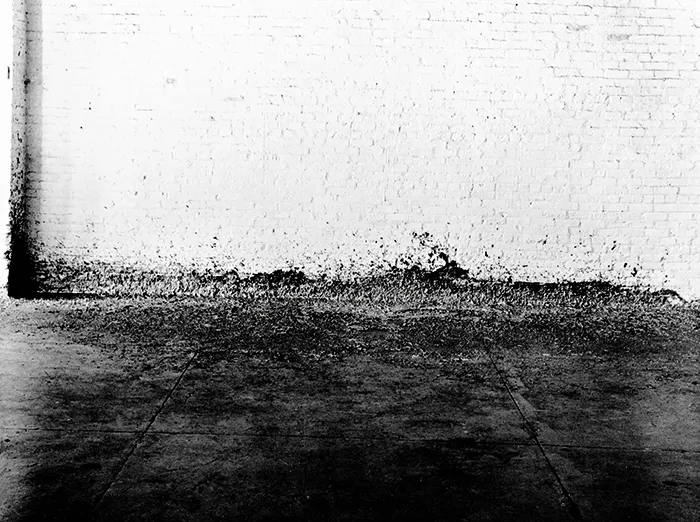
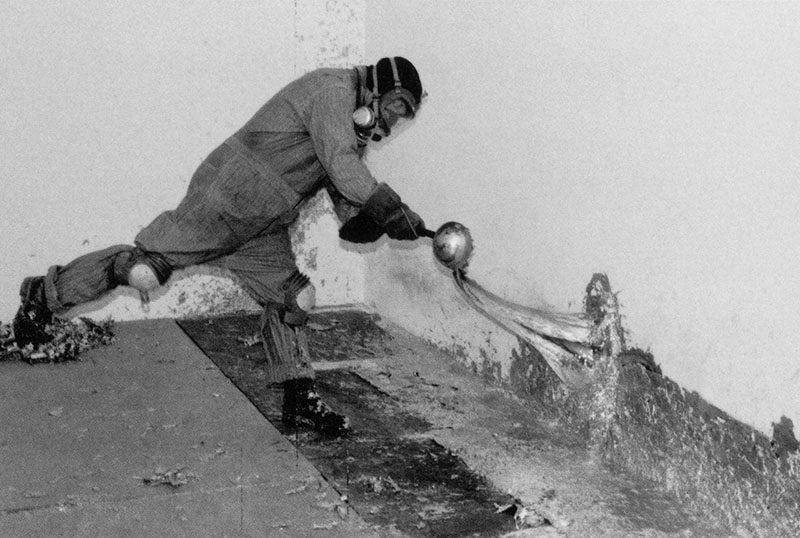
The Prop Pieces (1969) advanced the same logic through balance and instability. Sheets of lead and rubber are held in place solely by gravity and counterpressure, without adhesives, forming structures that appear on the verge of collapse and sharpen the viewer’s awareness of risk, mass, and the thin line between equilibrium and failure. Here, instability is not a gimmick; it is the point. The work forces the body to read space as a field of forces rather than a neutral container.

Credit: © Richard Serra / Artists Rights Society (ARS), New York. SFMOMA collection.
This is where Serra’s most quoted proposition gains its full weight. In a widely cited catalogue interview, he insists that “space is a material,” and that articulating space has come to prevail over other concerns. In Serra’s practice, space is not what surrounds sculpture. Space is what sculpture makes.
SCALE, WEATHERING STEEL, AND THE PUBLIC ARENA
From the 1970s onward, Serra increasingly committed to steel, especially weathering steel (COR-TEN), an industrial material that oxidizes into a stable, dark rust-like patina. Outdoors, the color shifts from gray to orange and eventually settles into a deeper tone over years, after which the surface becomes visually more uniform.
The significance is not simply aesthetic. Weathering steel turns time into a visible property. It insists that sculpture is not frozen; it changes, even when it stands still. And it carries the infrastructural aura of bridges, shipyards, and dams, an aura Serra did not borrow as a metaphor but recognized as part of the material’s social history.
As Serra’s works grew in scale, they moved beyond the studio’s protected conditions into the friction of public life. Site-specificity became not a curatorial label but a principle: the work’s meaning depends on the place, the route, the light, the context of movement. This shift set the stage for Serra’s most famous public controversy.
TILTED ARC: A SCULPTURE THAT WOULD NOT STAY QUIET
In 1981, Serra installed Tilted Arc at Federal Plaza in Lower Manhattan: a curving wall of raw steel that cut across the space, approximately 120 feet long and 12 feet high. It did not politely frame the plaza; it re-scripted it. People crossing the square could not ignore it; they had to walk around it, forced into detours that made them newly conscious of their own paths.
The work performed exactly the kind of activation Serra pursued: a sculpture that reorganizes perception by reorganizing movement. Yet the very mechanism that made Tilted Arc conceptually rigorous also made it politically vulnerable. Many local workers and passers-by found it obstructive; complaints framed it as ugly, inconvenient, even threatening. What followed became a defining moment in the history of American public art.

Credit: Photo © Archive of Destruction / Richard Serra.
In March 1985, the General Services Administration held public hearings. In widely cited accounts of the proceedings, more than 180 people spoke, and testimony strongly favored retention. Nonetheless, Tilted Arc was removed on March 15, 1989, dismantled, cut into sections, and placed into storage, a fate Serra regarded as equivalent to destruction because the work was conceived for that site and cannot be “relocated” without losing its identity.
The legal struggle surrounding removal is documented through court records and subsequent summaries of Serra’s case against the U.S. General Services Administration. Yet the deeper consequence was cultural: Tilted Arc became a touchstone in debates over who “owns” public space, whether the public’s discomfort is a legitimate reason to remove challenging art, and how far an artist’s intent can be protected once a work is commissioned and installed.
VARA AND THE QUESTION OF INTEGRITY: WHAT THE CONTROVERSY CHANGED
It is common to link the Tilted Arc controversy to the broader U.S. movement toward recognizing artists’ “moral rights,” rights tied to attribution and integrity. The Visual Artists Rights Act (VARA) is the key federal statute in this area, granting authors of qualifying works rights to claim authorship and to prevent intentional distortion or destruction of works of “recognized stature.”
However, precision matters. Tilted Arc was removed in 1989. VARA was enacted in 1990 and took effect in 1991, and its applicability is limited, including explicit boundaries around conduct that occurred before the effective date. So, rather than saying Tilted Arc “led directly” to VARA as a single cause, the more accurate formulation is that the controversy became a powerful public case study, an emblem within the debates that culminated in the legislation.
In that sense, Tilted Arc remains less a personal defeat than a historical pivot: it taught institutions, city administrations, and the art world that site-specific work is not merely a movable asset. It is a spatial contract, ethical, political, and experiential. Serra’s insistence that removal equals destruction continues to shape how we discuss public commissions today.
TORQUED ELLIPSES: FROM AGGRESSION TO INVITATION
By the 1990s, Serra’s work entered a mature phase in which the violence of confrontation gave way to a more complex invitation. The steel did not become soft. But the experience became more labyrinthine, more internal, more attuned to how time thickens inside curved space.
The Torqued Ellipses series (begun 1996) exemplifies this shift. First presented at Dia in New York in 1997, these works are composed of towering steel plates whose top and bottom ellipses are offset, producing a twist, “torque,” that destabilizes the viewer’s sense of vertical alignment. Walking inside, one can feel a mild dizziness, as if the work tilts the world.

Credit: © Richard Serra / Artists Rights Society (ARS), New York. Installation view.
The forms are often associated with architectural lineage. Discussions frequently reference Serra’s interest in Borromini’s curved Baroque spaces, an influence he did not copy but transformed into a contemporary bodily experience. In Serra, curvature is not ornament; it is a device that reorganizes proprioception, turning walking into a kind of reading.
A technical nuance matters here. Serra’s working process is often described as beginning with models and then moving through computer-aided calculation and engineering (including CATIA) to determine positions and angles for fabrication. This framing keeps the hierarchy clear: digital tools can support the precision required for large steel construction, while the sculptural intelligence still emerges through iterative modeling, testing, and spatial judgment.
Where earlier works could feel confrontational, with walls that cut space and planes that obstruct, Torqued Ellipses creates interior paths. The steel no longer merely blocks; it receives. The visitor is not simply redirected but absorbed into a controlled drift of curves. Serra described such forms as “receptacles,” emphasizing that the work holds voids as much as it holds mass.

Credit: © The Solomon R. Guggenheim Foundation / Richard Serra.
THE MATTER OF TIME: BILBAO AS A MACHINE FOR WALKING
If Torqued Ellipses re-centered Serra’s practice around interior experience, The Matter of Time made that experience orchestral. Installed in the largest gallery volume of Frank Gehry’s Guggenheim Bilbao, the installation is conceived as a group of eight weathering-steel sculptures, designed to be perceived together with the room as part of their spatial field.
The visitor does not “view” The Matter of Time; the visitor enters a sequence of spatial events. Elliptical shells open and narrow, spirals draw you inward, corridors widen unexpectedly, and curvature becomes a narrative. One senses the evolution of Serra’s vocabulary from simpler enclosures to complex spatial coils, not as a timeline on a wall, but as a lived choreography.

Credit: © Guggenheim Museum Bilbao.
The title itself points to Serra’s dual premise. “Matter” names the steel, its mass, friction, compression, and industrial lineage, while “time” names both the slow transformation of weathering steel and the temporal experience produced by walking through changing spatial conditions. As the surface oxidizes and stabilizes, time becomes a property of the material; as the viewer moves, time becomes a property of perception.
In this sense, Bilbao becomes more than a host museum. It becomes a machine for walking: a controlled environment in which movement generates awareness. The work’s scale is not spectacle for its own sake; it is a requirement. Only at this scale can space be sculpted as a primary medium. The elongated gallery becomes part of the spatial field, and entering the room is, in a real sense, entering the sculpture.
MONUMENTA, DESERTS, AND THE LATE PUBLIC WORKS
Serra’s late period did not end with Bilbao. He continued to produce major projects that expanded the geographical and conceptual reach of his work.
In 2008, Serra realized Promenade for Monumenta at the Grand Palais in Paris, a monumental intervention that staged steel as both architecture and procession. The event confirmed Serra’s capacity to treat vast civic interiors as material: the building’s grandeur did not dwarf the sculpture; it became part of its rhythm.

In 2014, Serra installed East-West/West-East in Qatar’s Brouq Nature Reserve: four massive steel plates aligned across more than a kilometer of desert landscape, calibrated to the topography so that their heights and placements register the land’s subtle shifts. The work’s alignment is not a trick of scale but a discipline of looking, an insistence that the landscape itself becomes legible through measured interruption.

These works demonstrate how Serra’s late practice moved between two extremes: the controlled interior (museum, grand hall) and the open horizon (desert, landscape). In both cases, the viewer’s body remains the hinge. The sculpture measures you by forcing you to measure it.
LEGACY: WHY SERRA STILL MATTERS
Serra’s death in 2024 prompted renewed attention to a body of work that had already become canonical. Obituaries emphasized not only his mastery of steel but the intensity with which he insisted on sculpture as lived experience, not public ornament.
His legacy is also institutional. Major museums preserve key documents such as the Verb List and continue to frame Serra’s practice through the lens of action and making, drawing as a verb, sculpture as a verb, and space as an active medium. His influence can be traced not as a simple line of inheritance but as a broader shift in how contemporary art understands scale, embodiment, and the ethics of site-specific work. Many later artists and architects working with immersive environments, whether in sculpture, installation, or spatial design, operate in a world Serra helped make thinkable.

Perhaps the most enduring lesson is Serra’s resistance to frictionless culture. In an increasingly digitized environment, where experience is often reduced to images and scrollable impressions, Serra’s work insists on the irreducible weight of real matter and the slow intelligence of moving through space. Steel, in his hands, becomes not a symbol but a condition: it forces attention, demands time, and returns perception to the body.
To stand within Serra’s curved steel is to feel that art can still do something stubbornly physical. It can interrupt habitual routes. It can make the familiar strange. It can turn space into material and time into a form you walk through. And in that encounter, between mass and movement, Serra’s sculpture continues to speak, not as decoration, but as a rigorous proposition about how we inhabit the world.
REFERENCES
Encyclopaedia Britannica. “Richard Serra.” (Encyclopedia Britannica)
Guggenheim Museum Bilbao. “The Matter of Time (1994–2005).”
Guggenheim Museum Bilbao. Teachers Guide: Richard Serra. The Matter of Time. (Educational PDF; includes material process notes, oxidation discussion, and CATIA mention.) (gsa.gov)
The Museum of Modern Art (MoMA). “Richard Serra, Verb List, 1967.” (Dia Art Foundation)
Dia Art Foundation. “Richard Serra: Torqued Ellipses (1997–1998).” (The Museum of Modern Art)U.S. General Services Administration (GSA). “Richard Serra, Tilted Arc (Art in Architecture / Federal Plaza).” (guggenheim-bilbao.eus)
Tate. “Lost Art: Richard Serra.” (Removal date; storage; overview controversy.) (tate.org.uk)
Cornell Law School, Legal Information Institute. “17 U.S. Code § 106A – Rights of certain authors to attribution and integrity (VARA).” (Legal Information Institute)
Cornell Law School, Legal Information Institute. “Visual Artists Rights Act of 1990 (Public Law 101–650) – enactment and effective-date provisions.” (Centre Pompidou)
Centre Pompidou. “Atelier Brancusi / Brancusi’s Studio.” (Visit Paris Region)
Qatar Museums. “Richard Serra: East-West/West-East (2014), Brouq Nature Reserve.”
Centre national des arts plastiques (CNAP). “Richard Serra – Promenade (Monumenta 2008).” (guggenheim-bilbao.eus)
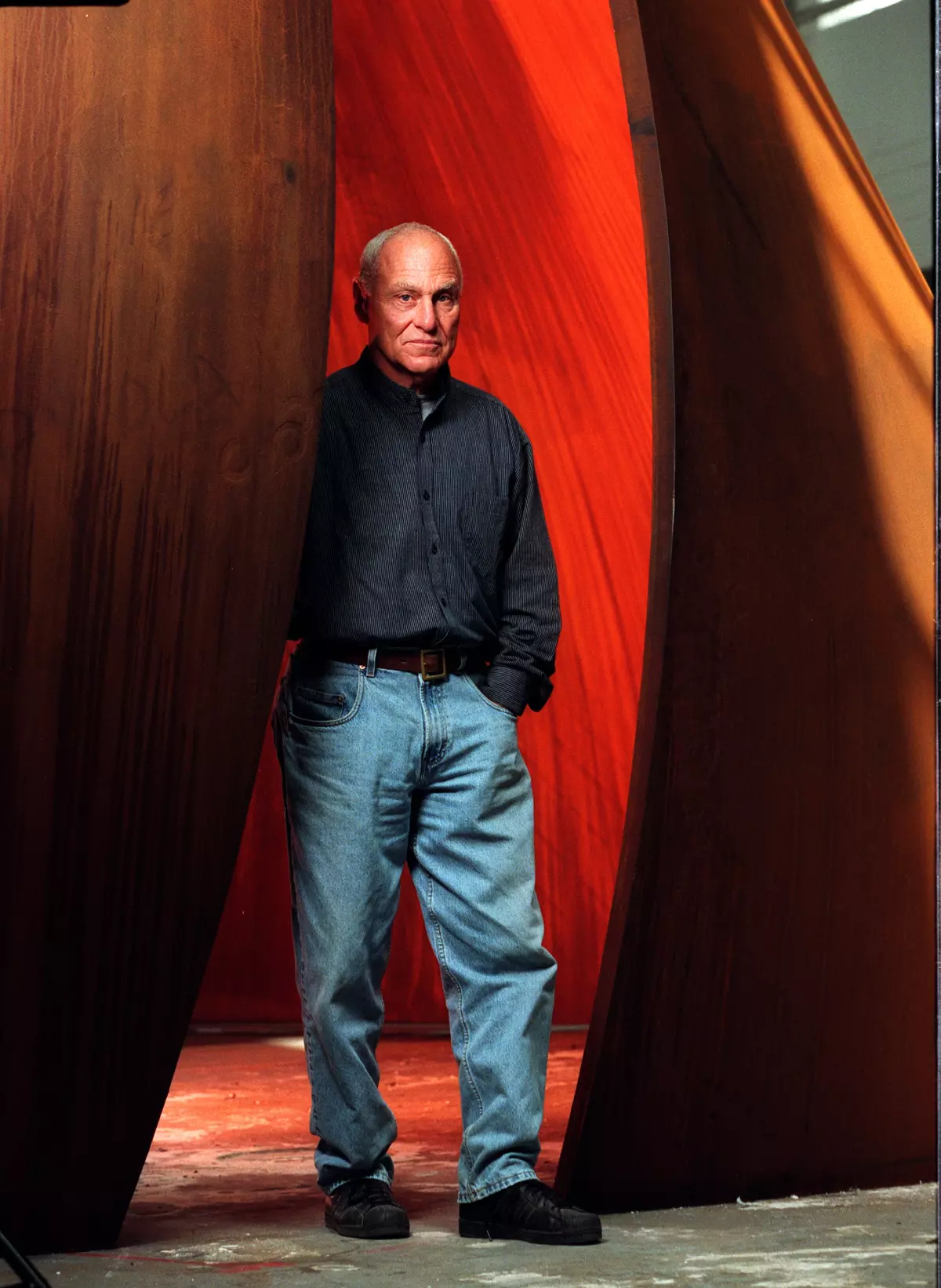

Photo Cover
Entering the labyrinth: weathering steel plates in The Matter of Time press against the body and recalibrate space. Credit: © Guggenheim Museum Bilbao / Richard Serra / Artists Rights Society (ARS), New York.