Now Reading: Donald Judd redefines architecture through permanent installations in Marfa
- 01
Donald Judd redefines architecture through permanent installations in Marfa

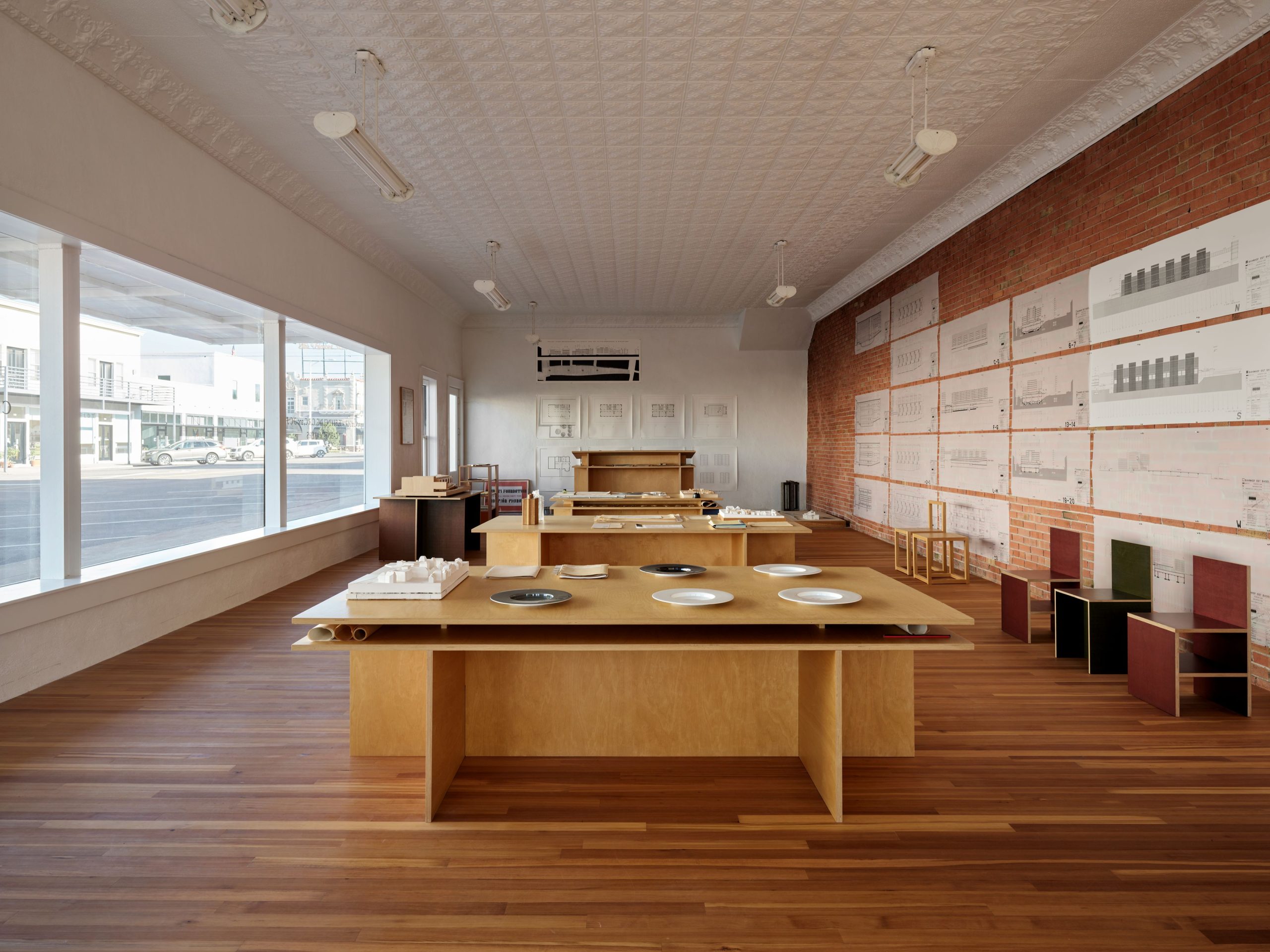

The room is almost empty. A table, a chair, a set of drawings held in quiet suspension. The reopened architecture office of Donald Judd in Marfa does not resemble a studio in any conventional sense. There is no visible production, no accumulation of models, no evidence of iteration as architecture typically defines it. What remains instead is a condition: a space calibrated for looking, for measuring, for deciding.


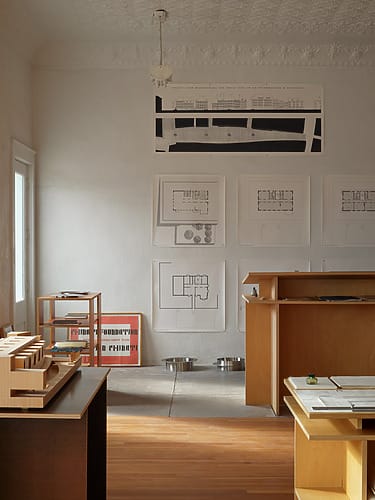
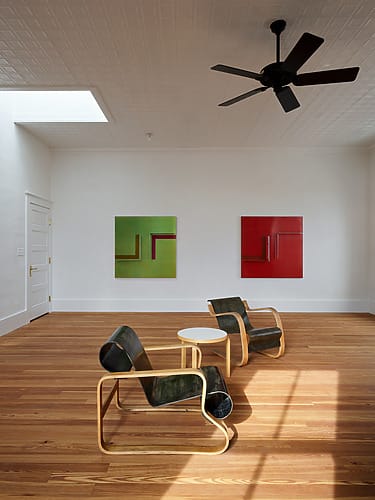
Installed within a modest two-storey brick building acquired in 1990, the office functioned simultaneously as a workplace and a site of habitation. The ground floor contained drawings, plans, and prototypes; the upper level, furnished with Judd’s own plywood furniture alongside works by figures such as John Chamberlain and Alvar Aalto, extended the same spatial discipline into daily life. It was, as his son later described, a place to look at drawings and think. Not to produce, but to decide.

To read this space as an archive would be to misunderstand its function. It does not preserve a practice. It exposes a method. Here, architecture appears not as a profession, but as a discipline of thought, one that resists mediation and insists on direct engagement with space.
Judd’s trajectory begins not with architecture, but with its refusal. In Specific Objects (1965), he dismantled the conventions of both painting and sculpture, rejecting illusion on one hand and composition on the other. What he proposed instead was a form that exists as itself, neither representing nor arranging, but occupying space with literal clarity.

The implications are architectural. Once the object is no longer defined internally, its meaning emerges through its placement. Space is no longer neutral. It becomes constitutive. The object depends on its surroundings to exist at all.
From this premise, Judd’s work unfolds as an expansion in scale. The object extends into the room, the room into the building, the building into the landscape. At each stage, the question remains unchanged: how can a thing exist, precisely and without distortion, in the world?
New York, where Judd established his early career, could not sustain this question. The gallery system imposed a regime of temporality: works were installed, removed, rearranged, and recontextualised. Space was treated as interchangeable, a neutral support for circulation and exchange.
Marfa offered a different condition. When Judd began acquiring land and buildings there in the 1970s, he was not retreating from the art world so much as redefining its parameters. Distance, scale, and time could now be aligned. Works would not be exhibited, but installed. Permanently.
This ambition materialised in the development of the Chinati Foundation, where large-scale installations were conceived to remain in situ indefinitely. The intention was explicit: to preserve the relationship between art, architecture, and landscape as a coherent whole. In this context, architecture ceases to function as a container. It becomes inseparable from the work it hosts.
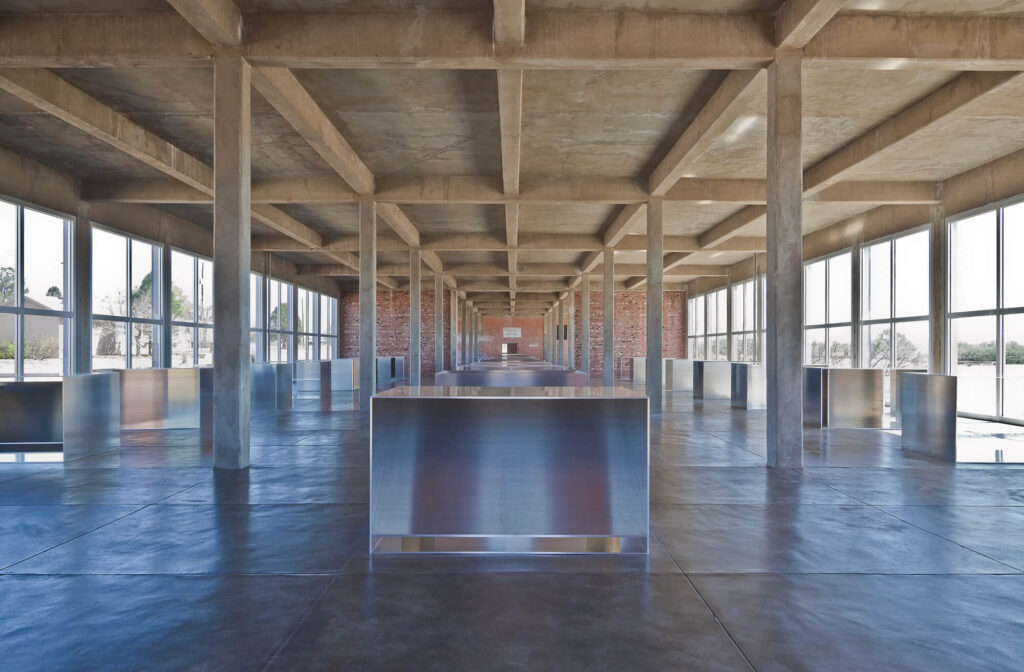
Judd’s spatial vocabulary is disarmingly limited. Repetition, proportion, alignment, and material precision form its core. Industrial materials such as aluminium, galvanised steel and plexiglass are employed not for their aesthetic associations, but for their capacity to maintain exact dimensions. Edges remain sharp, surfaces unmodulated, and joints are exposed rather than concealed.
Credit: © Judd Foundation.
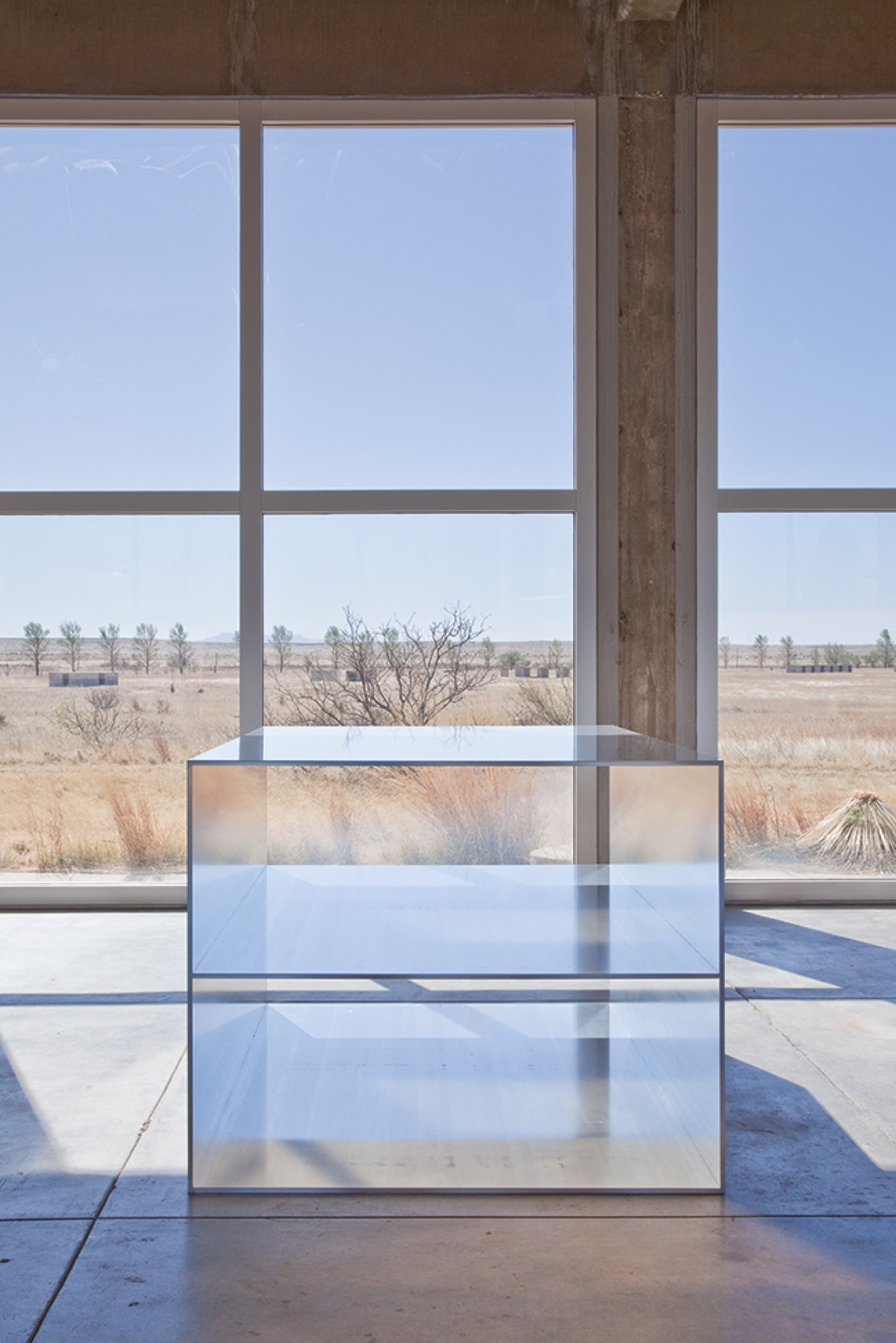
Light, particularly the severe and shifting light of the Texan desert, is treated as a material condition. It enters through precisely positioned openings, altering perception without ever being manipulated. Over the course of a day, identical objects diverge in appearance. The work remains constant; the conditions do not.

Credit: Florian Holzherr © Judd Foundation

What is absent is equally significant. There is no symbolism, no narrative, no compositional hierarchy. Judd does not design forms. He establishes relationships. Between objects, between objects and walls, between interior and exterior. Space is constructed through distance, interval, and proportion.
In Marfa, these principles extend beyond the scale of the object into a total spatial system. Former military structures such as artillery sheds, hangars and barracks were acquired and carefully recalibrated, while new elements were introduced with restraint. The result is neither a conventional campus nor a fixed master plan, but a distributed spatial condition in which each component is precisely positioned and mutually defined.

Within the artillery sheds, one hundred aluminium units are arranged in strict sequence. Each is identical in dimension, yet never perceived as identical. Light enters from one side, casting gradients across surfaces, producing a slow oscillation between uniformity and difference. Outside, concrete works align with the horizon, their spacing measured against the vastness of the landscape. Distance itself becomes a structuring device.

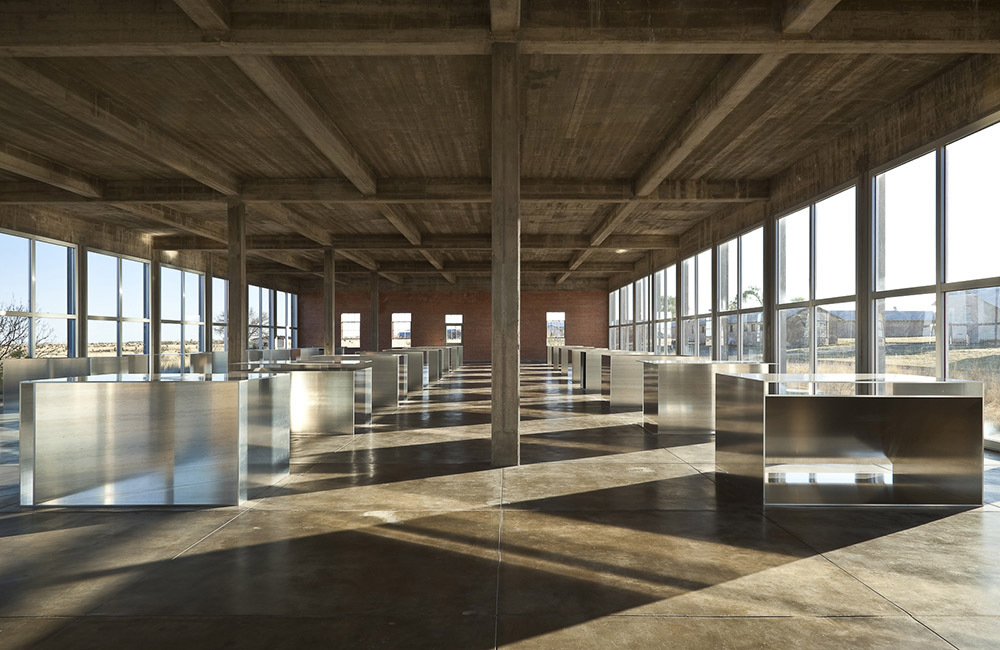

This is architecture without image. It does not present itself all at once. It unfolds through movement, through duration, through attention.
Yet this pursuit of precision is continually tested by material reality. Judd’s architectural works were not immune to failure. Adobe walls cracked, roofs leaked, construction costs escalated beyond expectation. His insistence on exactness often collided with the limits of available techniques and the unpredictability of matter.
These frictions do not undermine the work. They define it. Judd’s architecture is not an aesthetic resolution, but an ongoing negotiation between intention and reality. Precision is not a given. It is something to be pursued, measured, and repeatedly reasserted.
The architecture office in Marfa condenses this tension into a single room. It is not a place of production, nor a finished work. It is a space in which decisions are tested against their consequences. Drawings function not as representations, but as instruments. Furniture is not decoration, but an extension of spatial logic. Living and working collapse into a single condition.
In this sense, Judd’s practice remains deliberately unresolved. It does not culminate in a definitive form. It persists as a method.
Perhaps the most radical aspect of Judd’s work is its refusal of neutrality. Space, for him, is never empty, never interchangeable. It is always structured, always specific, always implicated in the experience of the work.

Marfa is not an escape from the world. It is a reconstruction of it, measured in intervals, held in light, and sustained through an uncompromising commitment to clarity.
Photo Cover
Interior of Donald Judd’s Architecture Office, Marfa, Texas, featuring plywood furniture, architectural drawings, and prototypes. Credit: Matthew Millman © Judd Foundation.