
Now Reading: Inside the Athens Studio of Kostas Lambridis: Material Equality in Practice
- 01
Inside the Athens Studio of Kostas Lambridis: Material Equality in Practice


It was under this calm warmth that we first met Kostas Lambridis. Standing in the light, he waved us up with an openness that immediately dissolved any sense of distance. Moments later, we were climbing the stairs to his second floor studio, where material hierarchy is deliberately suspended and everything is allowed to speak.
Lambridis describes his approach as “material egalitarianism”. In his practice, copper holds no inherent superiority over plastic, nor does carved antique wood claim more value than automotive waste. Objects collide, merge, and transform, not to erase their origins, but to renegotiate their meaning.


A STUDIO AS A LIVING ARCHIVE OF MATTER
Beyond the blue iron door, the studio reveals itself through smell as much as sight. The earthy scent of aged timber blends with the sharp clarity of polished metal. The space feels less like a workshop and more like a living archive, each zone quietly devoted to a different state of matter. Wood logs over two meters tall stand upright and solemn, while carved blocks await their next assembly. Metal fragments bear unusual textures, their surfaces telling stories of pressure and alteration. Marble reflects a cool, restrained light, while plastic elements scatter color across worktables.
“It doesn’t matter to me whether something came from the trash or cost a thousand euros,” Lambridis says. “I treat it with the same respect, or the same irreverence.”


After eight years working at Nacho Carbonell’s studio, Lambridis returned to Athens to establish his own practice. His background in engineering, combined with formal artistic training, gives him an unusually precise sensitivity toward construction, joints, and structural logic. His works unfold through open narratives, consciously or unconsciously merging disparate materials and forms until a new coherence emerges.
FROM APPRENTICESHIP TO INDEPENDENT VOICE
This attitude crystallized in Elemental Cabinet, the graduation project that first drew international attention. The piece echoes the silhouette of Florence’s most lavish Baroque furniture, while quietly undermining the logic of preciousness itself. Decorative references from ancient and contemporary craftsmanship coexist within a single object. Bronze, ceramics, embroidery, and fragments of melted plastic chairs are brought together, collapsing the boundary between original and reproduction, between noble material and everyday residue.


LIGHT, COMPRESSION, AND REVERSAL OF PROCESS
Light plays a central role in the studio. Stained glass casts patterned shadows on the walls. Reflections from copper sheets overlap with the cool glow of neon. Lambridis switches on a chandelier from a series recently shown in Paris. LED bulbs connect to vintage incandescent lights, colored glass panels are embedded with copper and aluminum sheets, and neon tubes coil around brass structures.
“Most people start with a small idea and expand it,” he explains. “That can be difficult. Here, we reversed the process.”
Different eras and technologies are compressed into singular forms, not layered nostalgically but pressed into coexistence. The result is neither collage nor provocation, but a controlled density where contrasts remain visible.


Over time, Lambridis’s work has shifted from aggressive collision toward a more measured symbiosis. “When you focus on one material,” he says, “you begin to discover its hidden complexity.”
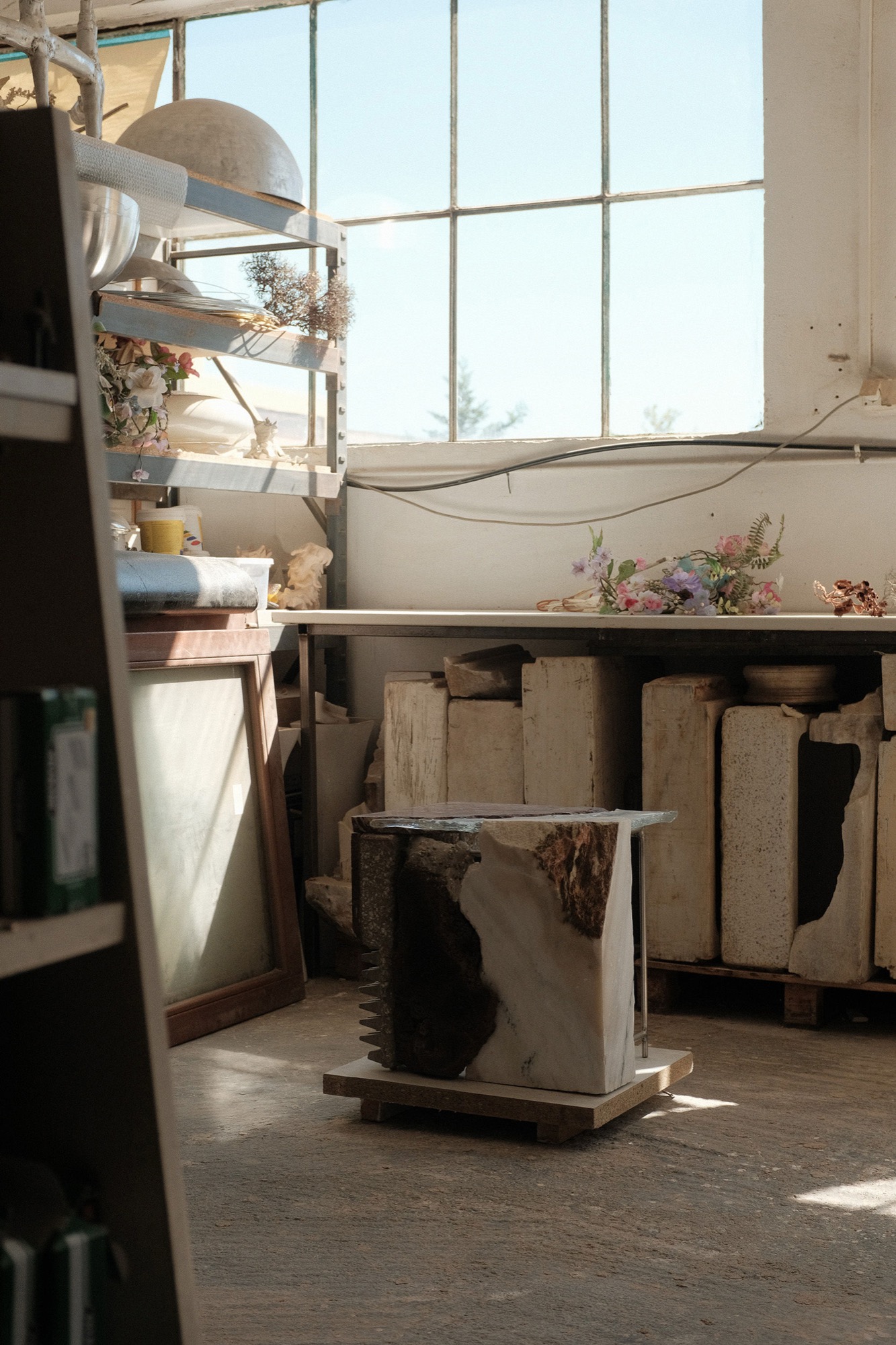
One early experiment involved completely crushing and reassembling an abandoned car. Its door was polished into a bar countertop, the original impact marks now resembling organic grain. “You can’t even tell it was a car door anymore,” he says, laughing. Nearby, a table composed of two stones presents a quieter dialogue. Sunlit white marble appears soft and almost warm, while the concrete side remains raw and unresolved. Between them, a translucent plastic surface mediates the transition, creating a delicate balance between opacity and transparency, refinement and tension.


CRAFT AS A PATH TOWARD REDUCTION
“Start with the most intricate craftsmanship, then simplify,” Lambridis suggests. He leans against a solid wood table, tracing the inlaid grains of American walnut and Portuguese cypress, as if listening to a conversation between species.
On another surface rests a model for a stage installation. Within days, it will rotate against the backdrop of the Acropolis, opera performers moving in orbit around it. Once again, the classical and the contemporary enter into dialogue, neither dominating the other. As we prepare to leave, small planters on the windowsill draw attention. Metal fragments are embedded in concrete, from which green shoots emerge. Materials once discarded now appear quietly alive, activated by light and care.


Perhaps this is the essence of Kostas Lambridis’s practice. Not the production of expensive artifacts, but the dismantling of prejudice through material transformation. In his work, nothing is elevated by rarity alone. Everything earns its dignity through use, reconfiguration, and the simple act of being allowed to exist on equal terms.
ARTICLE CREDIT
Artist: Kostas Lambridis
Location: Athens, Greece
Photo: Paris Brummer
Editor: Jinjie
Source: YinjiSpace