
Now Reading: The Willow Play Café in Toronto by Denizens of Design and DS Studio blends café and play space
- 01
The Willow Play Café in Toronto by Denizens of Design and DS Studio blends café and play space

The Willow Play Café in Toronto by Denizens of Design and DS Studio blends café and play space

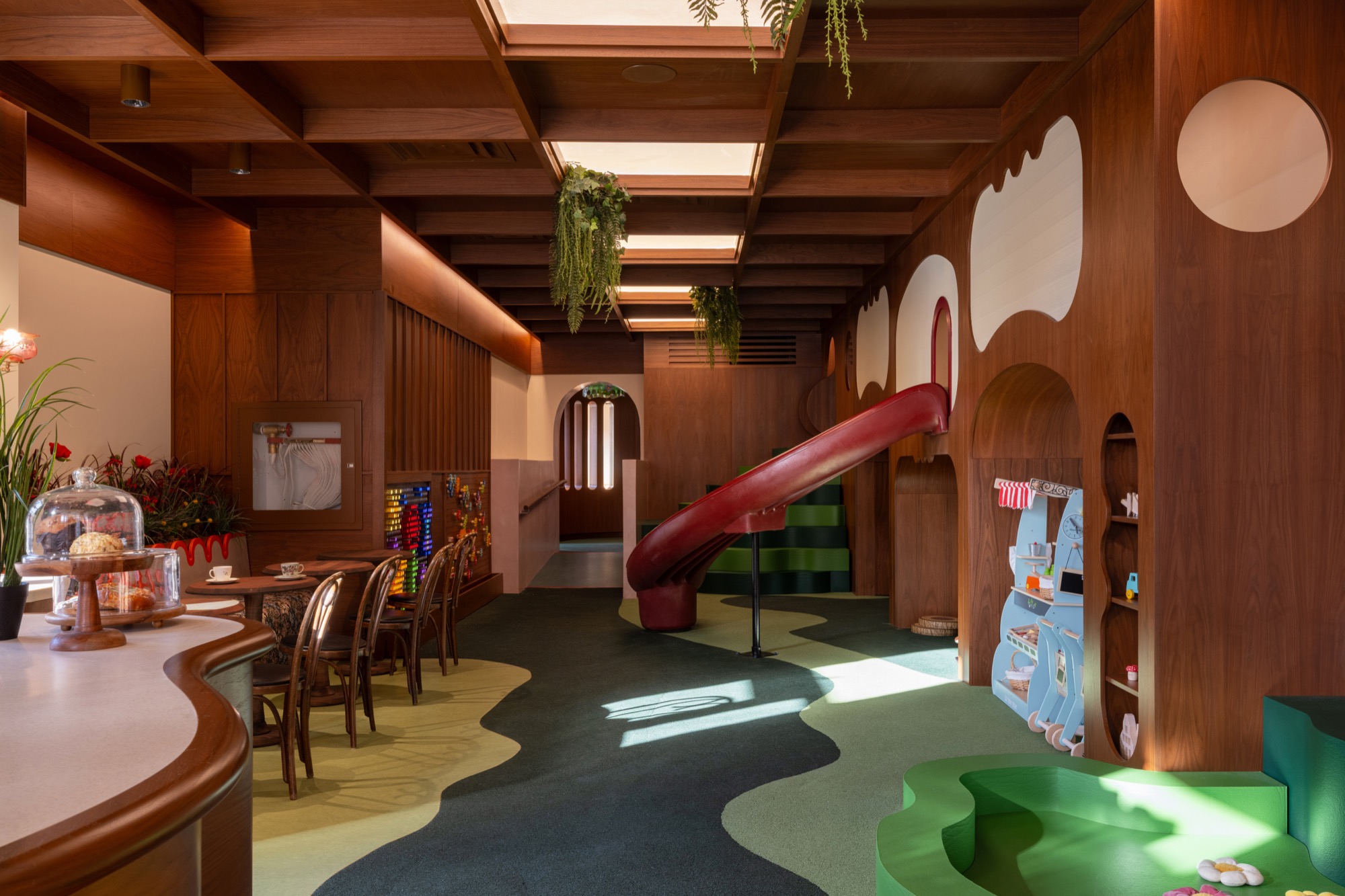
In Toronto’s Junction neighbourhood, a former dive bar has been quietly transformed into a new kind of social interior. The Willow Play Café, designed by Denizens of Design in collaboration with DS Studio, proposes an alternative model for how families inhabit the city, one that moves beyond the separation of adult and child environments toward a shared spatial experience.

Rather than positioning itself as a playground with an attached café, the project reverses the logic. It begins with the familiar language of a neighbourhood café and gradually unfolds into a layered environment where play is embedded within the architecture itself.

This shift is not merely programmatic. It reflects a broader cultural condition, where millennial parents seek to retain fragments of their pre parental urban rituals while accommodating new forms of care and attention. The Willow responds by constructing a space where lingering, observing, and participating coexist without hierarchy.
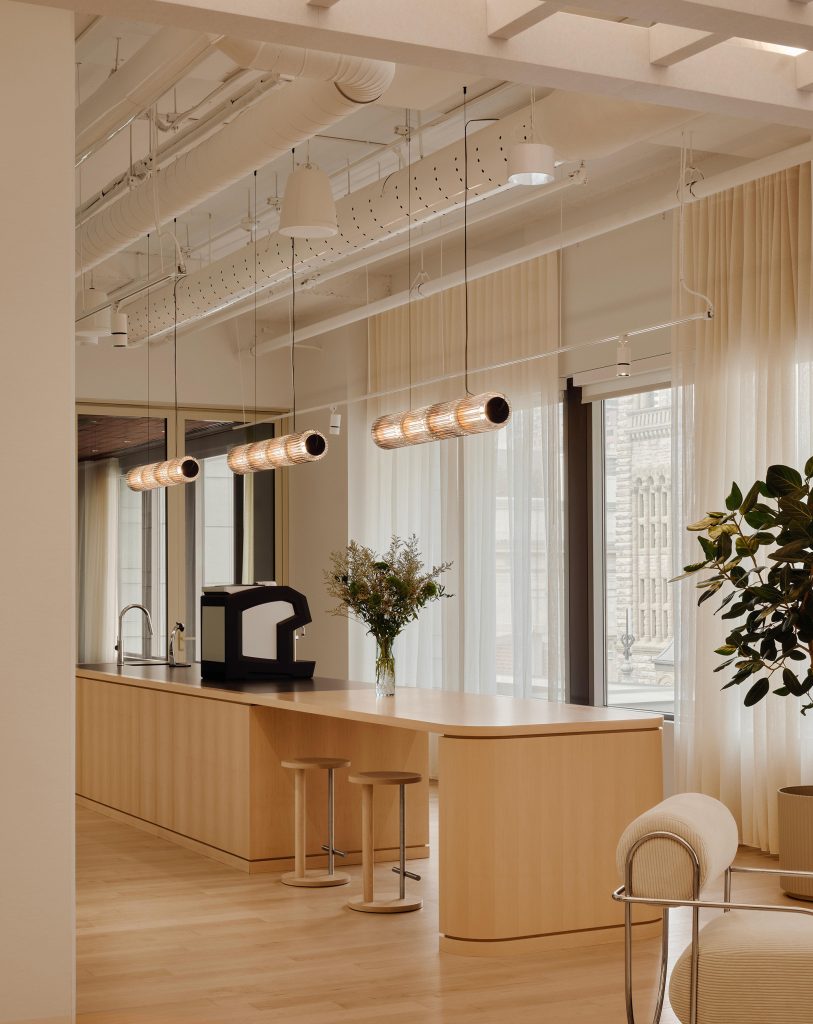
The interior is grounded in a restrained material palette that recalls mid century and early twentieth century café typologies. Warm wood panelling, checkerboard linoleum flooring, bentwood chairs, and softly diffused lighting establish a sense of continuity with the past.


Yet this familiarity is deliberately unsettled. Architectural elements begin to shift in scale and meaning. Millwork thickens into inhabitable surfaces. Walls become interactive interfaces. Decorative gestures reveal themselves as latent play structures.


At the centre of this transformation is the conceptual presence of a willow tree. Rather than being represented literally, it is translated into spatial conditions, curvature, and atmosphere. The ceiling undulates, openings soften into organic apertures, and suspended greenery introduces a sense of vertical drift. The result is an interior that oscillates between domestic calm and quiet surrealism.


The reference is less to the explicit imagery of children’s environments than to narrative spaces, where perception is constantly renegotiated. The café becomes a forest, the room becomes a sequence, and architecture becomes an active participant in play.
A key spatial threshold is marked by a large keyhole shaped portal, signalling the transition from café to play environment. Beyond this opening, the material language shifts subtly but decisively. Rubber flooring, sculptural foam steps, and integrated climbing elements form a two level landscape that accommodates movement, rest, and observation.

Importantly, these elements are not treated as additions but as continuations of the architectural logic. Seating is embedded within the play zones, allowing parents to remain physically and visually connected to their children. Circulation is fluid, avoiding the typical zoning that separates supervision from participation.
This approach reflects a careful negotiation between safety and spatial openness. Forms are softened, edges are rounded, and transitions are gradual, enabling exploration without disorientation. The project demonstrates how playground design strategies can be absorbed into architectural thinking without becoming didactic.

The Willow extends beyond recreation into a pedagogical framework informed by STEM based play and the Reggio Emilia approach. Interactive walls, tactile installations, and puzzle based elements are integrated directly into the wood panelling, dissolving the boundary between furniture, surface, and activity.
This integration reinforces a key idea: that learning is not confined to designated zones but distributed throughout the environment. Children are not directed toward specific activities but encounter them as part of their movement through space.
In this sense, the project operates as a micro urban condition, where exploration, discovery, and social interaction unfold simultaneously. The architecture does not prescribe behaviour but creates the conditions for it to emerge.


What The Willow ultimately proposes is a redefinition of the “third space”, traditionally understood as a setting distinct from home and work. Here, that concept is expanded to include intergenerational occupation, emotional continuity, and spatial hybridity.
It is a place where the rituals of adulthood and the impulses of childhood are not separated but intertwined. Where a cup of coffee and a moment of play occupy the same architectural field. Where memory and imagination are allowed to coexist without resolution.


In doing so, the project offers a quiet but significant shift in how interior architecture can respond to contemporary urban life. It suggests that the future of communal space may lie not in specialization, but in the careful layering of experiences within a single, cohesive environment.
Project Credit
Project name: The Willow Play Café
Location: Toronto, Canada
Design: Denizens of Design / @denizensofdesign, DS Studio / @dsstudio.ca
Photography: Scott Norsworthy / @norsworthyscott